
Consultancies are often challenged when it comes to managing contracts, invoicing and revenue recognition as well as analysing customers, projects and employees.
Typically, these organisations sell a host of services – usually consulting hours, but also courses or standard services. Some customers purchase prepaid hours (like a ticket coupon), while others purchase entire projects on a fixed-price basis.
Getting an overview of the company's contracts, the number of hours left on a prepaid hours contract or which projects are in need of renegotiation with the customer can be very difficult. Often, the result is a delayed reaction resulting in lost revenue. Even more difficult is attaining a reliable forecast. How much of your revenue is booked, and how big is your cash flow?
Eight types of contracts
Most consultancies use the time and material contract as their primary method of invoicing. Usually, invoices are issued once a month, listing the amount of time spent on a given project.
If the consultancy is project-oriented, or if they sell products instead of hours, the settlement method often moves toward a fixed-price contract, possibly based on a payment plan in accordance with the major deliveries of a project or task.
Lastly, there are many companies employing what you might call "periodic invoicing". These are typically auditors, accountants and companies offering standard services and invoicing customers at standard amounts (on-account or fixed-price) on a monthly, quarterly or annual basis. These consultancies can benefit from partially automated invoicing systems and periodic rather than shipment-based budgeting.
For these types of businesses, the usual challenge of managing contracts and finances is that 90% of business follows fixed contract principles in a catch-all system, but the remaining 10% differ due to special agreements, new product areas or creative negotiations. This scenario is made even more challenging for companies mixing time and material, fixed-price assignments and periodic business.
For the sake of simplicity, let us group consultancy contracts in eight main types (four based on time and material on four on fixed prices).
- Time and material
o Ongoing invoicing
o On-account invoicing with end-balancing
o On account invoicing with periodic balancing (ongoing contracts)
o Prepaid hours
- Fixed price
o Invoicing based on a payment plan with per-project revenue recognition
o Invoicing based on a payment plan with per-task revenue recognition
o Continuous service (ongoing contract)
o Volume invoicing (ongoing contract)
Each main type holds anomalies, for example time and material at maximum budget and special rules for revenue recognition at a fixed price.
In TimeLog
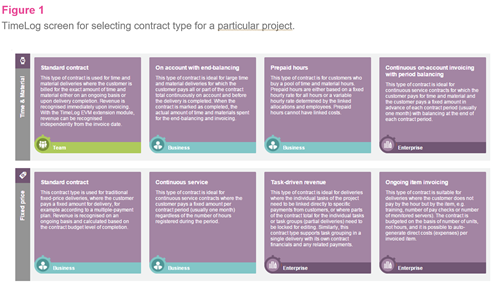
TimeLog supports all eight common contract types for consultancies. Each project can contain an unlimited number of contracts – even multiple simultaneous fixed-price contracts or time and material contracts. The type of contract defines the invoicing method, the revenue recognition method and whether the contract is ongoing or finite.
For example, a project may have a major delivery at a fixed price with subdeliveries on time and material and an ongoing maintenance service in effect until the customer chooses to discontinue it. This project may be invoiced quarterly at a fixed amount.
See Figure 1.
Security settings
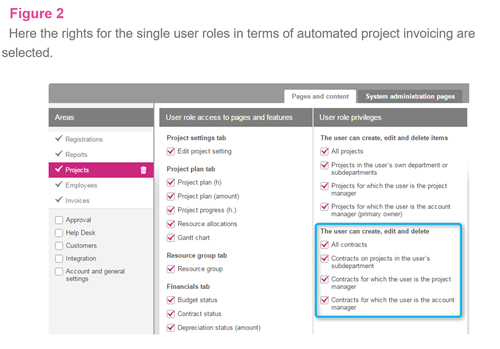
When the system administrator allocates a role to an employee in TimeLog, the system administrator decides if the role can create, edit and delete contracts. The settings are made in the System administration under Employees -> User roles and rights management -> (Select role). Hereafter, you select Projects and User role privileges under the Pages and content tab.
The eight types of contracts
In the following sections, we will go through all eight types of contracts and best practices on automated project invoicing for consultancies.
Time and material – ongoing invoicing
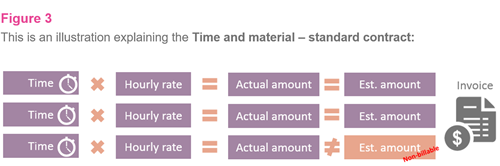
This type of contract is for simple and very common contracts for which the customer is invoiced continuously based on time and materials spent. The project manager is free to define hourly rates for employees, assignments or in general. Invoicing is based on consumption.
This type of contract is widely applicable and used for in-house projects without specific customers to invoice (the contract is simply set to be non-billable), and for delivery projects and ongoing consultancy.
As regards accounts, this type of contract is very simple, as revenue typically follows invoicing (except for very large projects).
In TimeLog
In TimeLog, the Time and material – Standard contract covers this type of contract. The contract contains a budget for work, expenses and travel expenses, which can be set as billable or not for each contract.
Hourly rates and invoicing settings are found in the project task plan. This type of contract holds an unlimited number of hourly rates and a highly flexible setup of billable versus non-billable work.
All contract types under Time and material can be set to disallow budget overruns (max. budget). If the budget is overrun, these hours will not be available for invoicing.
Time and material – on-account invoicing with end-balancing
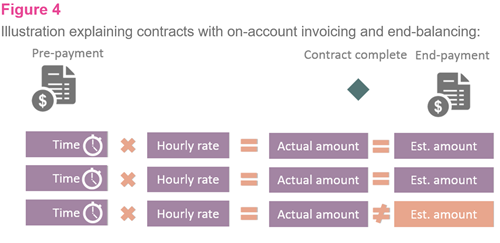
This type of contract is a variety of the common Time and material – standard contract. Long-term, fairly large projects use this type of contract, where the supplier has requested payment for part of the total budget before and during project work, but where the final consumption is to be invoiced upon project completion.
One example is a time and material contract with an agreed budget of EUR 13,500 for which the customer accepts an advance payment of EUR 6,700, an additional EUR 1,300 half-way through the project and the remaining amount upon completion. As the contract is based on time and material, the remaining amount is the difference between the cost of the work performed and the EUR 8,000 paid, which is then invoiced before delivering the project.
In TimeLog
In TimeLog, the On-account invoicing with end-balancing contract covers this scenario. The contract type is a mix between time and material and fixed price. A payment plan of on-account payments is created for ongoing invoicing. Project hours and costs do not appear for invoicing while the contract is active, but they are available for booking as revenue.
When the contract ends, TimeLog automatically creates a negative payment on the contract to offset invoiced on-account payments and then releases the hours and costs of the contract to the final invoicing.
Time and material – on-account invoicing with periodic balancing
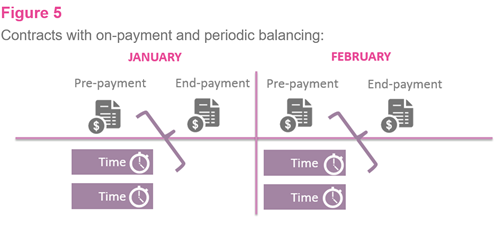
This type of contract is typically seen in industries with an ongoing and well-established cooperation between customer and supplier. Here, the supplier invoices the customer for a budgeted amount every period in advance – typically monthly or quarterly.
Once the period is over, the prepayment is offset against the value of the actual work performed during the period. The customer then receives an invoice including both this balance and the prepayment for the coming period.
This type of contract is often used in consultancies providing ongoing and unspecified assistance for their clients. Another type of fixed-price contract, the Continuous service contract, is based on a well-defined periodic payments.
In TimeLog
In TimeLog, the contract entitled Continuous on-account invoicing with period balancing covers this scenario. As with the On-account invoicing with end-balancing, this type of contract is a combination of time and material and a fixed price.
Using the same model as for creating recurring events in calendar systems, the user creates an invoicing plan, e.g. first day of each month. In time, new on-account payments are automatically added to the invoicing plan. Hours and expenses appear for invoicing along with the on-account payments. Every time an on-account payment is invoiced, a negative offset is created at the end of the same period, which is then invoiced together with the factual amount of time and material.
If you are not using the extension module, on-account periods are concluded (in terms of booking revenue) by finishing the financial period to which they belong. With revenue recognition is done manually, as values are controlled personally.
Time & material – Prepaid hours
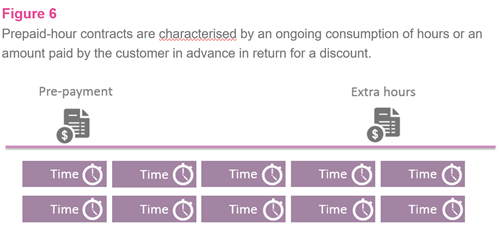
For knowledge companies and, in particular, the IT industry, we offer a Prepaid hours contract. The customer purchases a pool of hours at a discount. The customer then spends some or all of these hours (like a voucher) on projects he needs carried out and then buys a new pool of hours, if needed.
There are a number of challenges with this type of contract:
- The customer wants to use certain parts of the prepaid hours for a project.
- The customer requires senior and junior services, which are priced fundamentally.
- The customer wants to pay for travel expenses using the prepaid hours.
- The supplier ends up spending more hours than purchased and must ask the customer for new hours afterwards.
- The auditor requests reports on work in progress based on these prepaid hours contracts.
- The customer wants a monthly report on the remaining amount of prepaid hours.
Although these contracts indicate the use of hours, financially speaking it is just a prepayment which is depreciated as the debt to the customer is settled.
In TimeLog
In TimeLog, the Prepaid hours contract covers this scenario. TimeLog regards prepaid hours as an advance invoicing of an amount – not hours as such.
Prepaid-hour contracts can be based on fixed hourly rates or variable hourly rates. For fixed hourly rates, the number of hours on the contract are closely tied to its monetary budget. If not, the hourly rate for each allocation determines the amount of money deducted from the prepaid hours per registered hour.
Like all other types of contract, the user can configure it to send an email if a certain percentage of the total contract amount is exceeded. This is useful in case you want to inform the customer before expiration and sell additional hours.
Invoicing based on a payment plan with per-project revenue recognition
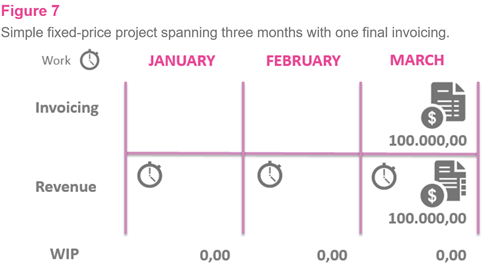
Typical fixed-price contracts are based on a fixed price agreed with the customer, which is used for invoicing when the purchased service/product is delivered. For fixed-price projects, the supplier carries the risk of budget overruns but, conversely, the supplier is able to achieve high hourly rates and contribution margins through effective project management.
Selling every product or service at a fixed price can be tempting, as it requires less administration and invoicing. On the other hand, it can be an unfortunate shortcut, as it poses increased challenges in terms of managing accounts, work in progress and the bottom line in general.
The challenges peak at long-term fixed-price projects, where revenue recognition is expected to follow performance. In other words, there is a need to continuously make a so-called completion level assessment for calculating turnover.
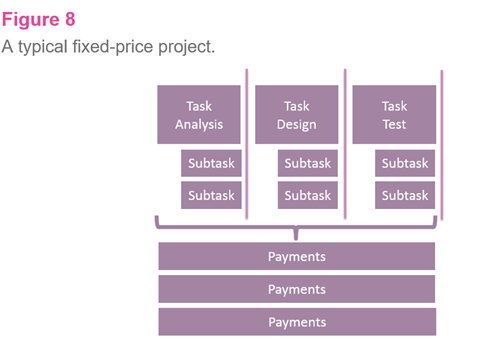
For example, in the case of major deliveries many companies prefer to invoice the customer on an ongoing basis: 40% of the contract total in advance, 50% after the first major delivery and 10% upon final delivery.
In TimeLog
In TimeLog, the Fixed price – Standard contract covers this scenario. As illustrated on the following page, this contract combines the customer's payment plan and a number of tasks in the project plan. All work and expenses registered on the contract share the total value of the contract. It is, however, possible to indicate if the expenses on the project are default billable when creating the project, as if it was a time & material project.
It makes it possible to invoice expenses on fixed price projects in the following ways:
- As part of the contract’s fixed price
- On an additional time & material contract, which is selectable when reporting expenses in TimeLog
- A combination of 2 and 3, where e.g. travel expenses are billed separately while subcontractors are including in the fixed price
The contract type Fixed price – Standard contract also lets you manage how much of the total accrues to work, expenses and travel expenses, if you select the first possibility above. In this way, the contract can have subcontractors without disrupting value calculations work (hourly rates etc.).
Items on the payment plan may well be products, making it possible to sell e.g. training, whereas underlying budgeting and revenue recognition is based on working hours.
Invoicing based on a payment plan with per-task revenue recognition
Some companies are particularly demanding when it comes to the level of detail in revenue recognition and invoicing. As such, viewing each project as a financial unit is insufficient.
This may be because every single task of a project has its own separate payment, which is released for invoicing as soon as the task is finished.
It may also be due to in-house procedures, revenue budgets (and bonuses) for individual departments, teams or employees. In these cases, dividing a project in a clearly defined and infrangible revenue framework might be prudent. Furthermore, this ensures that if a department, team or employee exceeds the budget on their part, the other parts of the project are not affected.
This is particularly interesting if payments for the individual sections of a contract are determined by the delivery. Example: a company who offers monthly salary management based on the number of payslips processed and supply consultancy at a fixed price per month. The easiest solution here is to group everything in one project and one contract while controlling the invoiced value for payslip processing only flows to work carried out on the payslip task.
In TimeLog
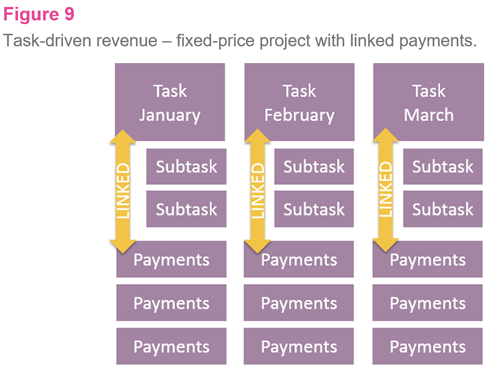
In TimeLog, the Task-driven revenue contract covers this scenario. As illustrated below, this contract combines the customer's payment plan and a number of tasks in the project plan. Unlike the Fixed price – standard contract, this type of contract lets you control exactly which parts of the payment plan go to which tasks and expenses.
By establishing a payment plan, the user can designate which task to link to the individual payment or choose to have the payment be part of a general payment plan. In this case, the task governs how much of the contract total is expendable.
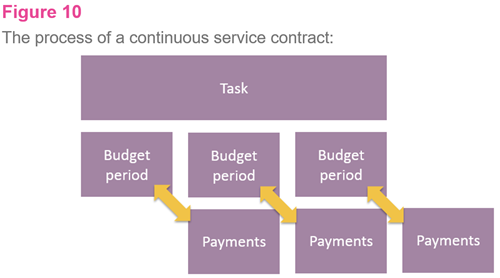
See Figure 9 and Figure 10 for a comparison of the two fixed price contracts.
Continuous service (ongoing)
Many IT companies, accountants and product-based companies supplying services based on monthly, quarterly or annual contracts, i.e. subscriptions. Customers are invoiced at a fixed monthly rate, regardless of the time spent completing the task in question.
Invoicing these contracts is not a demanding job per se; it can be solved using one of many financial systems supporting subscription invoicing.
The main challenge is once again revenue; for a company measuring revenue based on departments, teams or employees, forecasting and revenue recognition need to take into account the fact that every period of the agreement cannot take in more than the invoiced value of the period as revenue.
In practice, many companies need to manually recognise revenue for work – a time-consuming and high-risk process. Also, the key figures are highly imprecise for the current accounting period, as the adaptation to periodic budgets is only performed in connection with bookkeeping.
In TimeLog
In TimeLog, the Continuous service contract covers this scenario. This contract type is characterised by a continuous payment plan at fixed intervals and usually no end date.
Using the same model as for creating recurring events in calendar systems, the user creates a payment plan, e.g. first day of each month. In time, new periodic payments are automatically added to the payment plan. Each period is considered a separate fixed-price project, where all registered hours and expenses share the invoiced value of the period.
You choose how much of the invoiced value flows to work, expenses and travel expenses.
Volume invoicing – ongoing contract
The fixed-price contract with volume-based invoicing is an advanced variant of the fixed-price service contract. These contracts are based on goods, not hours, despite these actually being consulting services. Here are some examples of contract types with consulting invoiced as items:
- Number of processed payslips
- Number of monitored servers
- Number of bookkeeping records
In more complex cases, a direct external cost of the goods in question may be attached, e.g. a software license etc. to be handled.
For consultancies, this type of contract is difficult to manage, as the number of items typically varies by month (e.g. number of payslips). Consequently, the monthly budget of the underlying work and the direct costs also vary by month.
In spite of this, IT systems usually do not support the volume invoicing contract, as it will require integrations between the company's financial system, time tracking system and order system or manual entrie
In TimeLog
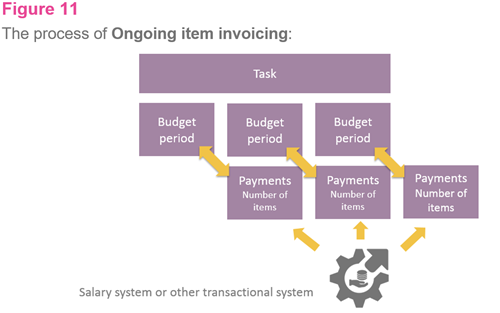
In TimeLog, the Ongoing item invoicing contract covers this scenario. Like the previously mentioned contracts, this one is characterised by a continuous payment plan at fixed intervals and usually no end date.
Using the same model as for creating recurring events in calendar systems, the user creates a payment plan, e.g. first day of each month. In time, new periodic payments are automatically added to the payment plan. Each period is considered a separate fixed-price project, where all registered hours and expenses share the invoiced value of the period.
This type of contract consists of the following key data:
- Number of expected units per period (e.g. 28 payslips or four servers)
- A unit price (e.g. EUR 15 per payslip)
- Possible discount (e.g. 10%)
- An hourly budget per unit (e.g. 0.25 hours per payslip)
- A unit cost (e.g. EUR 1.50 per payslip for salary management software)
Based on the above key figures, the contract calculates a payment plan and a cost plan. When the user updates an item in the payment plan, the payment and all associated costs are recalculated. The number can be updated via TimeLog API, e.g. using a salary system.
Get the full overview across projects
To get the total overview of your finances, work in progress on your contracts and make invoicing of the different payments easier, you need to make yourself familiar with the following two interfaces.
Data extraction: Contracts
The report Data extraction: Contracts is useful, if you want to follow up on e.g. invoicing and time tracking on all contracts for a specific customer or project manager. The report provides a good overview of the single contract’s finances, and you choose which details you want to include.
As default, the report shows all active contracts on all active projects with the possibility to filter to other views. You find it in the Reports menu.
Read the help text to Data extraction: Contracts here.
Adjust project payments
The Adjust project payments functionality helps you keep track of which planned payments you have in a given time period. This overview is specially designed for project managers and bookkeepers as they can easily update all project payments in one place and at the same time mark the payments ready for invoicing. It makes the process before invoicing much easier.
If you sell specific service such as courses, payslips or service licenses, you can also use this functionality to update different information, e.g. discounts or number before the monthly invoicing.
As point of departure, the page Adjust project payments shows all not invoicing payments on both active and inactive projects and contracts which a payment date in the current month. By also showing payment on inactive projects, you make sure that
everything is invoiced and nothing is forgotten. You find it under the Projects menu. This new interface supports Auto save, which means that your information is updated, as soon as you leave the field.
Save your favourite search
It is possible to export data to e.g. Excel, and you may expand the report to include more data, if there is a need for it. If you have a favourite search, you can make it default under Page settings, where you can also select to have data shown immediately when you enter the report.
Read the help text to Adjust project payments here.
The clear financial view
Supporting a variety of contract types to meet the needs of customers is a balancing act. The main thing to remember is that, as a company, you have the clear financial view of your financial situation and work in progress in order to collect your due payments. We experience a lot of companies who end up missing out on earnings, e.g. by running all projects at a fixed price, resulting in a low average hourly rate because work is more time-consuming than estimated.
Key to this is finding the proper management tools to support your processes and help you control finances, while assessing and focusing on the most profitable projects, invoicing and customers. The result is a solid foundation built on facts, not a gut feeling, for making strategic decisions.